Tag: Ai for Education

  • How Artificial Intelligence Can Improve Learning Outcomes in Kenyan Classrooms

    How Artificial Intelligence Can Improve Learning Outcomes in Kenyan Classrooms

    By Fidelis Makhambala

    The introduction of free primary education in 2003 and other interventions led to an increase in the number of learners enrolled in Kenyan schools.  The current primary school population stands at 10.4 million in both private and public primary schools.    

    Such a large enrollment comes with its challenges. They include inadequate infrastructure, teacher shortages, large classrooms, dropouts, inadequate psychosocial support, and addressing children with special needs.

    Artificial intelligence (AI) can be used to address some of these challenges in education today and improve learning outcomes.  

    Limited Internet Connectivity

    Africa has the widest gap in connectivity, with 23 percent of the population lacking access to a mobile broadband network. In Kenya, some areas are seen as commercially unviable and remain underserved in terms of internet connectivity. This disparity helps perpetuate inequalities among communities.

    M-Shule is an example of an EdTech platform that leverages AI and SMS technology. It provides personalized learning content to primary school learners in Kenya in places with limited internet connectivity through SMS.

    Teacher Shortages and large classes

    As of 2023, there was a shortage of 111,870 teachers.  The global teacher shortage has brought about pressure on school systems, such as overcrowded classrooms, overworked educators, increased inequality in education, and financial pressure. Apart from delivering content to learners, the teacher has several administrative activities. The Teachers Service Commission has 18 professional documents that a teacher is required to maintain. 

    AI can automate some processes to free the teacher to concentrate on teaching and supporting learners. Hodari is an app that allows the teacher to grade, make lesson plans, and carry out administrative tasks. 

    Overcrowded classrooms usually lead to less effective teaching methods and reduced individual attention and guidance to learners. AI can be used in digital assistants to engage with students individually, answer questions, and break down difficult concepts. One such tool is somanasi accessible through a single mobile platform. 

    Reducing dropout rates 

    UNICEF estimates that 1.3 million Kenyan children of primary school age are out of school. AI can detect learners who are likely to drop out of school.  Using predictive analytics, AI can scrutinize factors such as attendance, academic performance, socio-economic background, and behavior patterns and offer early warnings about students in danger of falling out of the formal education system. This allows educators to intervene before disengagement ends in dropping out.

    Economic hardship is a barrier to education. AI offers a way to help schools target support where needed most. By analyzing socio-economic data, AI can identify students at risk of dropping out due to financial challenges and recommend resources like scholarships, meal programs, or other forms of assistance.

    School violence in the form of harsh discipline, physical fights, social exclusion, and the spreading of rumors affects children’s ability to learn effectively. Victims and witnesses of these forms of school violence have a higher chance of missing classes, performing poorly, and dropping out of school. 

    Emotional AI-driven chatbots and mental health apps such as Chat Care can provide students with immediate support and resources to address mental health challenges. Developed by the Kenya Red Cross Society, it provides discreet psychosocial support addressing sensitive issues that may affect learners. It is available 24/7 on various digital platforms.

    Inadequate Teacher Training:

    AI-powered platforms can create customized training for teachers, addressing their specific learning needs. By assessing a teacher’s existing skills, knowledge gaps, and subject expertise, personalized professional development plans can be crafted.

    As teachers progress through training modules, AI systems provide instant feedback, helping them refine their understanding of new teaching methods. For instance, if a teacher struggles with classroom technology integration, AI can suggest resources and practical tips.

    These platforms can deliver bite-sized training sessions that fit the teacher’s busy schedule. These focused modules cover specific skills, such as digital assessment tools or project-based learning techniques.

    Nyansapo AI is an example of a platform that provides teachers with AI-powered tools and resources to help them develop foundational literacy and math skills among learners.

    Provision of Resources for Special Education Services:
    An inclusive education system recognizes that learners have different learning styles and needs. Customizable learning paths can be achieved using AI, such as somanasi, to assess student progress and adjust the curriculum. A student struggling with a topic is offered alternative teaching strategies or resources to reinforce understanding.

    Assistive technology is crucial in improving access to education. Knock Knock is a gadget that captures different sounds from the environment and translates them into visual and vibratory alerts for individuals with hearing loss.

    The Future

    In Kenya, AI could revolutionize teaching, elevate learning practices, and serve as a lever for achieving Sustainable Development Goal 4 of quality education for all. As UNESCO mandates, AI should be human-centered, and inclusive, one that narrows rather than widens existing divides in access to knowledge and cultural diversity.
  • The Role of Artificial Intelligence in Preserving Africa’s Indigenous Languages

    The Role of Artificial Intelligence in Preserving Africa’s Indigenous Languages

    By Mariana Kemei

    Ouma Katrina may not be a household name across the African continent, but for those in Southern Africa and among language enthusiasts, her name is a poignant reminder of the urgent need to preserve the Njuu language, South Africa’s oldest indigenous tongue. Like Njuu, many other African languages are critically endangered and face the threat of extinction.

    African languages are a treasure of history, culture, and traditional knowledge. However, many of these languages are on the verge of disappearing due to globalization, cross-cultural marriages, urbanization, and the dominance of widely spoken languages such as English and French. According to Kapodgroup, Africa has over 2,000 languages, and losing one would erase unique cultural identities and worldviews.

    The most endangered languages are often minority languages, spoken by less than 50% of the population in specific areas. This is why Ouma Katrina has been regarded as a national treasure in South Africa; she was the last remaining native speaker of Njuu following the deaths of her two sisters, Hanna Koper and Griet Seekoei.

    Vambo Academy in South Africa was established to provide a platform for people to learn indigenous languages. They initially focused on Zulu, Shona, and Afrikaans. However, the COVID-19 pandemic prompted a shift from physical classes to online learning through Zoom, a transition that proved successful.

    This transition laid the foundation for Vambo AI, born out of the increasing demand to digitize African languages. During this year’s EdTech Summit, Linah Kitala, Community Manager for Vambo AI, captured our attention when she reassured a delegate that AI could support his native language.

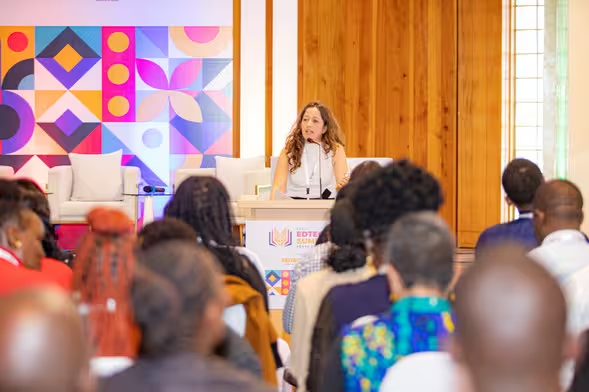
    The conversation was sparked by questions from María José Ogando from AI-for-Education.org, who walked us through the current landscape of AI-Edtech products in Sub-Saharan Africa, highlighting the opportunities and challenges as technology continues to evolve. Speaking during this year’s Edtech Summit, Maria shared that AI educational products are expanding rapidly, but we are seeing a gap in quality assurance and AI benchmark datasets targeting the teaching and learning process. 

    Few EdTech startups have ventured down the path Vambo has chosen: preserving African culture through technology.

    According to African World Initiatives, African languages lag in natural language processing (NLP), large language models (LLMs), and AI research, largely due to a lack of quality datasets. Maria acknowledged this as one of the challenges they face, stating that though AI educational products are expanding rapidly, there is a gap in quality assurance and AI benchmark datasets targeting the teaching and learning process.

    Documentation is an effective method for preserving endangered languages. AI can play a pivotal role in recording and transcribing spoken languages, making it easier to create dictionaries, grammar guides, and other linguistic resources.

     Kabodgroup recommends that written records, transcriptions, and recordings be created for every minority or endangered language to aid in their preservation. NLP tools can then be used to automatically transcribe audio recordings of native speakers, converting spoken words into text with high accuracy.

    Another approach involves creating and maintaining large-scale digital archives of African languages, including audio recordings, texts, and cultural artifacts. These archives can be made accessible online, allowing people worldwide to explore and learn about these languages.

    Many Africans have moved away from their native homes for socio-political reasons, in search of better opportunities. In such situations, people may lose contact with native speakers and, consequently, fail to learn their ancestral languages. Digital archives can bridge this gap, making it easier for displaced people and others to learn these languages, thereby preventing their extinction.

    AI helps to curate and organize these archives, making it easier to search for specific words, phrases, or cultural contexts. Machine learning algorithms can continuously update and expand these archives as new data becomes available, ensuring that languages are preserved for future generations.

    This is how Vambo is building its indigenous language platform, continually updating existing content. As Linah said, “Building is a process.”

    With many African languages at risk as older generations pass away, Linah emphasized the importance of embracing digital tools to preserve our linguistic heritage. Without these efforts, we risk creating an irreparable void once a language becomes extinct.

    To ensure that Africa’s cultural legacy endures, we must pass on our languages to future generations. According to Kapodgroup, a language’s longevity largely depends on the quantity of its speakers. Preserving and growing our languages digitally is crucial to keeping them alive and relevant for the future.

     While it is important to ensure that African languages are preserved digitally, it is also important to ensure LLM models are fed with good-quality local educational content. Digital companies should source their content from the local people to avoid passing on incorrect information and losing the true meaning of native African languages. Maria suggested the need to develop benchmarks that will give guidance on how AI should be used not only to teach but also to preserve African languages.